Why Birth Time Accuracy Can Destroy or Save a KP Prediction
Short answer: money comes when the chart supports 2, 6, 10, and 11
If your effort is not becoming wealth, stop asking only whether your chart has money. That question is too broad to be useful. In KP, money has to be broken into parts. The 2nd house shows what you save and retain. The 6th house shows money earned in return for work or service. The 10th cusp must be checked for job and professional stability. The 11th house shows gain and fulfilment of income. When these houses support each other, money can come, stay, and grow. When they do not, money may still come and leave just as quickly.
This is where many people misunderstand their own lives. They say, “I work so hard, so why am I not rich?” Because work is not the same as wealth. Work can activate the 6th house. Salary can come. Cash flow can move. But unless the 2nd house supports saving, that cash may never become stored wealth. If the 10th cusp does not support stability, the job itself may remain irregular. If the 11th is missing, gains may not justify the effort.
A practical example is easy to imagine. Two employees can earn the same salary. One pays rent, food, loans, and family support, then still saves a fixed amount. The other spends freely because “the salary is coming anyway.” Both are earning. Only one is building wealth. In KP terms, that difference is not only about discipline; it is also about whether the chart supports retention.
In KP, do not romanticize money. Trace it. Where does it enter? Where does it stop? Where does it leak? The chart shows the difference.
The real problem: people confuse income with wealth
Most money problems are not one problem. They are usually several separate problems mixed together. One person earns well but saves nothing. Another has talent but unstable work. Another gets customers but cannot retain money. Another receives investment but handles it badly. If you call all of this “wealth” and treat it as one issue, you will miss the actual cause.
The 2nd house shows wealth in the practical sense: what remains with you. If money enters your account and leaves within days, that is not wealth. That is movement. The 6th house shows money earned through work or service. You deliver something and cash flows in return. This can show salary, job-related cash flow, service income, and the practical earning mechanism. The 10th cusp must also be checked when the question is about career and job. The 11th house brings gain.
So when someone says they are facing an income block, the first question is: block where? Is the person not getting work? That is one issue. Is the person working but not being paid properly? Different issue. Is the person paid but unable to save? Different again. Is the person earning but the money goes to partners, family, customers, loans, repairs, healthcare, vehicles, or other expenses? Again different. KP is useful because it forces you to be specific.
There is also a blunt truth here. Money is a commodity that moves from one person to another. If it is with you today, tomorrow you may give it to someone else. If someone else has it, they may give it to you. Money is circular. So the chart must show not just receiving money, but retaining money. A person can have strong cash flow and still remain financially weak if retention is not supported.
Consider a freelance designer who gets repeated projects. On paper, she is “earning.” But every payment disappears into software subscriptions, home expenses, client revisions, and travel. She is busy, useful, and respected, yet financially thin. The problem is not that money does not come. The problem is that money does not stay. That is the difference KP makes visible.
The KP judgment logic for money
1. Start with the 2nd cusp for savings and stored wealth
The 2nd cusp is critical because it shows whether money stays. If the cusp does not give 2, 6, 10, or 11, you can be sure the person is not able to save money properly. This is not a poetic statement. It is a practical judgment. If the 2nd does not connect to the money-producing houses, the person may keep trying and still feel that nothing accumulates.
Especially when the 2nd cuspal sublord is Saturn, the matter becomes more disciplined and delayed. Saturn wants structure. Saturn does not like casual handling. In such a case, savings may come properly only after 35 to 37 years of age, or the person may need strict financial discipline much earlier. If 10,000 comes in, the first expense should not be lifestyle. The first movement should be toward saving, safety, gold purchase, SIP, mutual fund, or some protected store of money. The method can vary, but the principle is fixed: money must be separated before it leaks.
This is not glamorous. It is boring. Good. Money often needs boring structure. A real-life pattern may look like this: a young professional gets a salary raise, celebrates with shopping, and then complains three months later that life is still tight. Another person with the same raise automates a transfer to savings on payday. The second person may not feel “rich” immediately, but the account balance tells the story. In KP language, the second person is cooperating with a supportive 2nd house pattern, while the first is letting income vanish before it can become wealth.
2. Check the 6th house for earned cash flow
The 6th house is the money earned in return for some work or service. It is cash flow because you have delivered something. If the 6th is active but the 2nd is weak, the person may keep earning and still not build wealth. They may be busy, employed, useful, productive, and still financially frustrated. That is not a contradiction. It simply means work is happening, but retention is not happening.
This is very common in salaried people and service providers. They say they have income, but no savings. The 6th is giving movement. The 2nd is not holding it. The solution is not motivational noise. The solution is to identify the weak point and behave accordingly.
Imagine a nurse working long shifts. She is dependable, always on duty, and her salary arrives every month. Yet she supports relatives, pays recurring household costs, and buys things for the family before thinking of herself. She is not lazy. She is not unemployed. But her 2nd house pattern, in practical terms, is not converting earnings into stored value. That is why two people with the same profession can have completely different financial lives.
3. Check the 10th cusp for job and professional stability
For job instability, the 10th cusp must be checked along with the 2nd. The 6th may show work and service income, but the 10th tells you whether the professional structure itself is supporting the person. If the 10th is not helping, the person may face breaks, dissatisfaction, role changes, or uncertainty about what to do next.
This is why one person can be talented and still struggle professionally. Talent is not the question. KP does not ask whether you are trying hard. KP asks whether the houses involved in work, income, savings, and gain are actually supporting the result.
A useful way to think about it is this: the 6th can show that you are able to serve, perform, and handle tasks. The 10th shows whether that service is standing on a stable professional base. Someone may be very good at their job yet keep changing companies because the role never settles. Another person may dislike the work but remain in one place because the structure is strong enough to hold them. The chart must be read for the real outcome, not the imagined one.
4. Use the 11th house for gain
The 11th house has to be part of the wealth conversation because income without gain is incomplete. If 2, 6, and 11 support each other, the money picture becomes stronger. If the chart gives a strong 2, 6, 11 pattern, money has a better chance of coming and staying. If three numbers support one side and only one number supports the other side, the picture becomes weaker. If support and loss both keep appearing equally, money may keep coming and going.
That last point matters. Some charts do not deny money. They create circulation. The person earns, spends, earns again, spends again. On paper they are not poor. In reality they are not secure either.
Think of a small shop owner who sees regular sales every day. He may feel successful because cash moves through the counter. But if each evening the stock has to be replenished, the rent is due, credit customers delay payment, and family expenses swallow the rest, the 11th house is not delivering gain in a durable way. Revenue is not the same as profit. KP keeps that distinction clear.
5. See the nakshatra lord and sublord levels when results oppose
Sometimes the nakshatra lord and sublord show opposing results. For example, one level may give 2, 6, 11, while another gives a pattern that does not support the same satisfaction. In that situation, do not mechanically declare one result. Ask what is actually happening in life. Are they having wealth? Are they having job satisfaction? If yes, they may still be operating at one level. If no, they may have come to another level. Then the advice has to be given accordingly.
This is where serious KP differs from lazy reading. You do not just see one number and announce destiny. You compare the levels and verify the lived result. A person may be earning through one channel, yet the emotional experience of money may be completely different. Another may feel financially comfortable but not have large visible income. The chart has to be matched with reality, not with assumptions.
Where money leaks in a KP chart
The 7th house: people opposite you
The 7th house is not only marriage. It represents the partner, the open enemy, the person standing opposite you, daily customers, business partners, life partners, and partnerships. Why is the partner also connected with the idea of open enemy? Because an enemy is someone on whom you lose time, energy, and money. Be honest. This can happen in partnerships too.
If money keeps leaking through partners, clients, spouse, collaborators, or people you are dealing with face to face, the 7th house must be examined. For business people, daily customers are also seen from the 7th. So the same house can bring money through customers and take money through partners. Do not label it good or bad too quickly. Understand how it is functioning.
For example, a consultant may depend on repeat clients. The 7th is bringing business. At the same time, a bad collaboration agreement may force unpaid revisions, scope creep, and delayed fees. The same house is helping and hurting. That is why the outcome must be read carefully.
The 8th house: not just bad luck
One of the most common mistakes is to treat the 8th house only as bad luck. That is incomplete. The 8th also brings other people's money. If you get an investment to build your business, that is 8th house. It can bring funding, investment, and resources that do not originate only from your own pocket.
The 8th also connects with occult knowledge such as astrology, tarot, numerology, and vastu. So if a person has money through these fields, the 8th cannot be dismissed as merely negative. It has to be used correctly. A business owner receiving investment and an astrologer earning through occult knowledge are both dealing with 8th-house themes in different ways.
For example, someone may join a startup with investor backing. The money did not come from personal savings, but it made the business possible. Or an astrologer may build income by offering consultations, teaching, or reading charts. That is also a real-world expression of the 8th house. The issue is not whether the 8th exists. The issue is whether it is handled in a way that supports the larger financial pattern.
The 12th house: controlled loss is better than uncontrolled loss
The 12th is loss and expenditure, but it can be handled consciously. Donation is also 12th. If the chart strongly shows 12th-type expenditure, one practical way is voluntary donation: lose some money consciously instead of losing money randomly. The point is not to become dramatic. The point is to give the 12th a clean channel.
Sometimes, if money is connected to certain people or areas, and if you are not receiving from them, at least spend a small amount there. Even a small size is fine. If 100 comes, put 15. If 1000 comes, put 200. The amount is not the main point. The point is to align the expenditure instead of letting it explode in an uncontrolled way.
This can be as simple as setting aside a fixed amount for donation, travel, or a planned expense instead of letting money leak in random emotional purchases. A person who never plans expenditure often feels that life is “expensive.” Often the deeper issue is not expense itself, but uncontrolled loss.
The common mistake: reading money from one house only
The biggest mistake is reading money from one house and declaring the whole financial destiny. Someone sees the 2nd and ignores the 6th. Someone sees the 6th and ignores the 2nd. Someone panics about the 8th and forgets that investment is also 8th. Someone blames bad luck while the real issue is that the 2nd cuspal sublord is Saturn and the person has no structure at all.
Another mistake is to chase the wrong earning channel. The sitting place of the 2nd cuspal sublord in the Bhav Chalat chart tells the first place where you should put money, or where putting money can help you get more money or save more money. This is very practical. If the indication is toward domestic environment, hospitality, restaurants, or real estate, then the person must examine those areas seriously. If the indication is toward content and social media through the 3rd and 5th houses, then recording, publishing, teaching a concept, or putting content online may become a money path.
But people do the opposite. They follow fashion. One year everyone wants trading. Another year everyone wants YouTube. Another year everyone wants a startup. Fine, but what does your chart say? The 5th house represents stock market, trading, and entertainment. The 3rd and 5th can connect with platforms like YouTube and Instagram. But if your money houses are not supporting that route, enthusiasm will not pay your bills.
This is where real-world discipline matters. A person may see social media success all around them and assume they should do the same. But if their chart points to another channel, such as service, domestic support, hospitality, or a different money route, forcing themselves into a fashionable field can waste months. KP helps reduce that mismatch.
Composite case 1: salary comes, savings vanish
Rohit is a 32-year-old salaried professional. Every month he gets paid. He is not unemployed. In fact, his work cash flow is decent. But by the end of the month, nothing remains. He says the same line many people say: “I do not know where the money goes.”
In KP terms, this is not mysterious. His 6th is active, so money comes in return for work. But the 2nd cusp does not strongly support saving, and the 2nd cuspal sublord is Saturn. That means wealth needs structure and discipline. Casual saving will not work. Waiting to save whatever remains at the end of the month will also not work, because nothing will remain.
The practical correction is simple and strict. The first expense after salary should be saving. If 10,000 comes, 2,000 must be moved immediately into a protected place such as savings, gold purchase, SIP, mutual fund, or another safety bucket. The chart is not saying he can never have money. It is saying money will not stay without structure. Saturn is not impressed by excuses.
He also has to look at his spending pattern honestly. If every salary increase turns into a phone upgrade, a nicer restaurant habit, or a family request that feels impossible to refuse, then the issue is not just salary size. The issue is retention. Without retention, income growth only increases the speed of leakage.
Composite case 2: talent online, but no steady income
Meera is good at explaining technical topics. She records occasionally, posts when inspired, disappears for weeks, then complains that online income is not coming. She also tries trading because someone told her the 5th house is active.
In KP logic, the 3rd and 5th houses can support social media routes like YouTube and Instagram. The 5th also represents entertainment, stock market, and trading. But there is a difference between having a theme and making money from it. For money to come and stay, 2, 6, and 11 have to support the result. If she wants money from content, she has to treat it as work, not mood.
If the 2nd cuspal sublord's sitting place points toward putting money and effort into communication or content, then she should record what she knows, publish consistently, and build a route where licensing fee, platform income, or service-based income can come. But randomly jumping into trading just because the 5th is present is foolish. The 5th shows the field. The money houses show whether it becomes wealth.
For someone like Meera, the practical answer may be to choose one lane for ninety days. If she has knowledge, she can package it into short videos, a course, or consultation content. Consistency can matter more than inspiration. The chart may show potential for a channel, but the result appears when the channel is used steadily.
Composite case 3: business grows, but partners eat the profit
Arvind runs a small food-related business. Customers come daily. Revenue is visible. But profit keeps leaking through partner disagreements, vendor adjustments, customer credit, and repeated reinvestment. He thinks the 8th house is ruining him because he took outside investment.
The reading has to be cleaner than that. Daily customers are seen from the 7th. Business partners are also 7th. So the same area bringing customers may also create leakage through the people standing opposite him. The 8th is not automatically bad here. The investment he received to build the business is also an 8th-house matter. Without that money, the business may not have expanded at all.
The question is not whether 7th and 8th are good or bad. The question is how they are operating with 2, 6, 10, and 11. If the business brings cash flow but the 2nd does not hold, he needs stronger saving discipline. If the second cuspal sublord's sitting place supports hospitality, restaurant, domestic environment, or real estate-related use of money, then putting money back into the correct business structure can help. But uncontrolled partner spending is not strategy. It is leakage with a business name.
In a case like this, the practical solution may involve clearer contracts, separate accounts, and a fixed rule for profit distribution. KP points to the pattern, but the person still has to act in the real world. Astrology does not replace basic business sense; it helps you see where basic business sense must be applied.
Practical takeaway: diagnose the exact financial failure
If you are facing money problems, do not ask a vague question like whether you will be rich. Ask better questions. Is money not coming at all? Is job unstable? Is cash flow present but savings absent? Are gains delayed? Are partners or customers consuming time and money? Is investment helping or creating pressure? Is the 12th demanding expenditure that you are not channeling consciously?
Use this basic KP checklist:
- 2nd house: What remains as savings and stored wealth?
- 6th house: What cash comes through work, service, job, or delivery?
- 10th cusp: Is the professional or job structure stable?
- 11th house: Are gains actually coming from the effort?
- 7th house: Are partners, customers, spouse, or people opposite you bringing money or taking it?
- 8th house: Is other people's money, investment, or occult knowledge part of the financial path?
- 12th house: Is expenditure controlled, voluntary, and directed, or random and painful?
Then check the 2nd cusp and 10th cusp carefully. If the cusp does not give 2, 6, 10, or 11, saving and stability become difficult. If the 2nd cuspal sublord is Saturn, do not behave like money will organize itself. It will not. Create structure. Save first. Spend later.
Also study where the 2nd cuspal sublord sits in the Bhav Chalat chart. That sitting place can show the first area where money should be put so that more money comes or more money is saved. This is one of the most practical parts of the judgment. It moves the reading from complaint to action.
For some people, the answer may be very simple: use money first in the area indicated by the sitting place, then watch the financial pattern improve. For others, the answer may be restraint: stop putting money into the wrong channel and allow the correct channel to build. In either case, the chart is guiding behavior, not just describing fate.
Money does not fail randomly in a KP chart. It either does not enter, does not stabilize, does not gain, or leaks through the wrong channel. Find the exact point. Then act accordingly.
That is the difference between serious astrology and casual hope. Serious KP does not flatter you. It shows the mechanism. If the mechanism supports 2, 6, 10, and 11, money has a path. If it does not, you need discipline, correct channel selection, and conscious handling of expenditure. Effort alone is not enough. Effort must be placed where the chart can convert it into wealth.
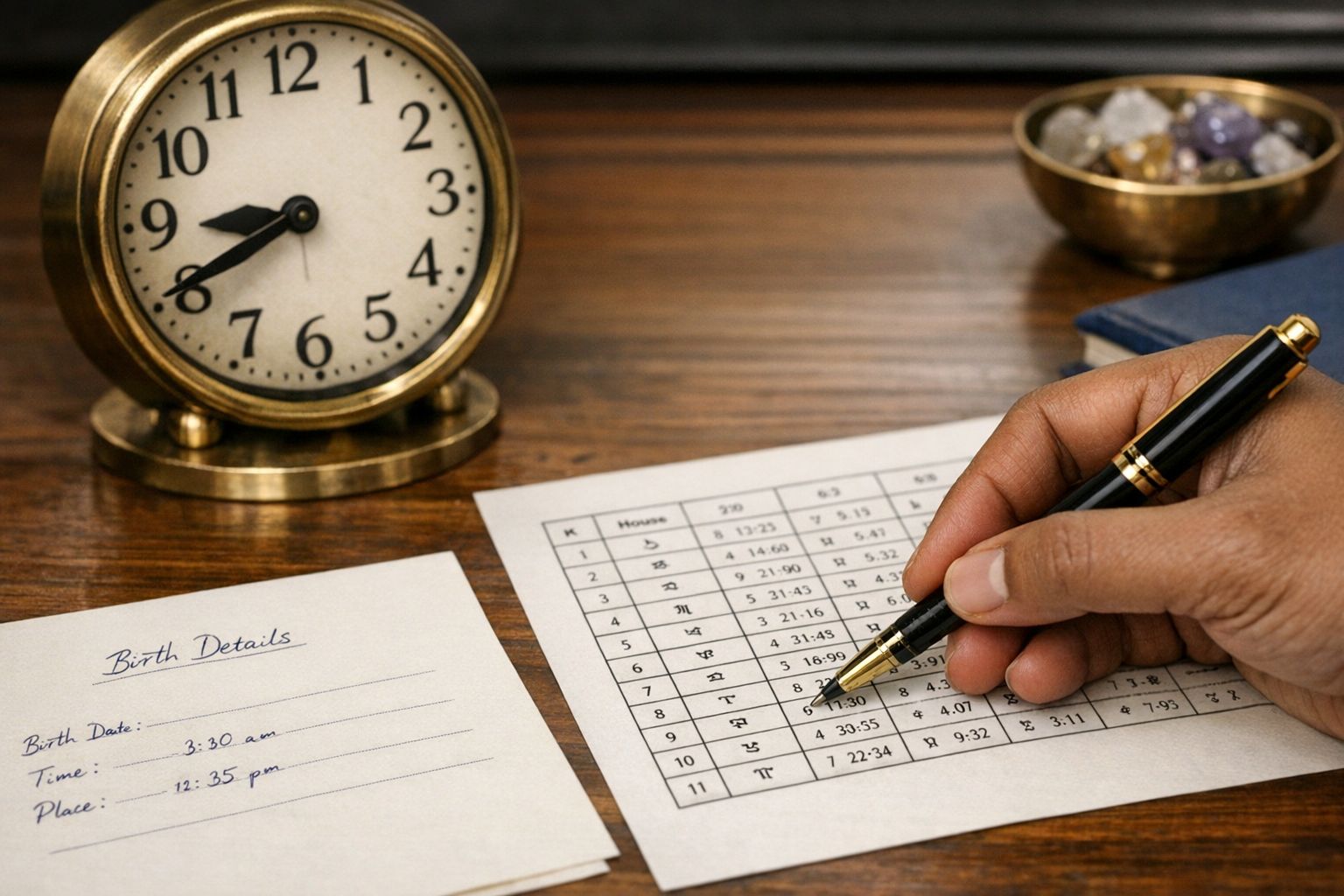
That practical mindset is also why clear birth time matters so much. A few minutes can shift the cusps enough to change the reading of money, job, and gain. If the time is wrong, the houses may be judged incorrectly, and the advice can miss the real issue. When the birth time is accurate, KP can become very specific about where money flows, where it gets blocked, and what type of action is most sensible next.
Explore More from KP Astro Academy
Related Tools & Features
- Childbirth Selection Tool
- Birth Time Rectification Tool
- Ruling Planets Calculator
- Marriage Matchmaking Calculator
- Career & Education Finder
- Transit Search & Prediction
- Planetary Remedies Finder
- Free KP Kundli
- Daily Panchang Calculator
- Vedic Ephemeris Calculator
- Hora Chart Calculator
- Ashtak Varga Calculator
- KP Event Finder
- Personal Muhurat Finder
- Cusp Promise Calculator
- Bhav & Dasa Phal Predictions
- Dasha Promise Calculator
- KP Astrology Consultation
Further Reading
- Childbirth in KP Astrology: Promise, Delay, Denial, and Hope
- Kp Significator Api For Event Prediction
- Astrology Pdf Report Generator Api
- How to Use Ruling Planets for Instant Predictions without a Natal Chart
- 🌕 The Navagraha Temples of Kumbakonam
- Why Does a Retrograde Star Lord Delay a Guru Bhukti Result in KP?
- 🔍 Ten Lessons from a Viral Post: What the ₹500 vs ₹5000 vs ₹50000 Debate Really Taught Me
- Complete Guide to House Significations in KP
- Closed Source Astrologer Workspace For Client Consulting
- Understanding KP Hit Theory the Right Way
- Astrologer Consulting Business Software
- Family Support or Family Obstacle? KP Reads It Without Drama
Loading article...