Transit Search in KP Astrology: How Planetary Transits Trigger Life Events

Transits in KP Astrology
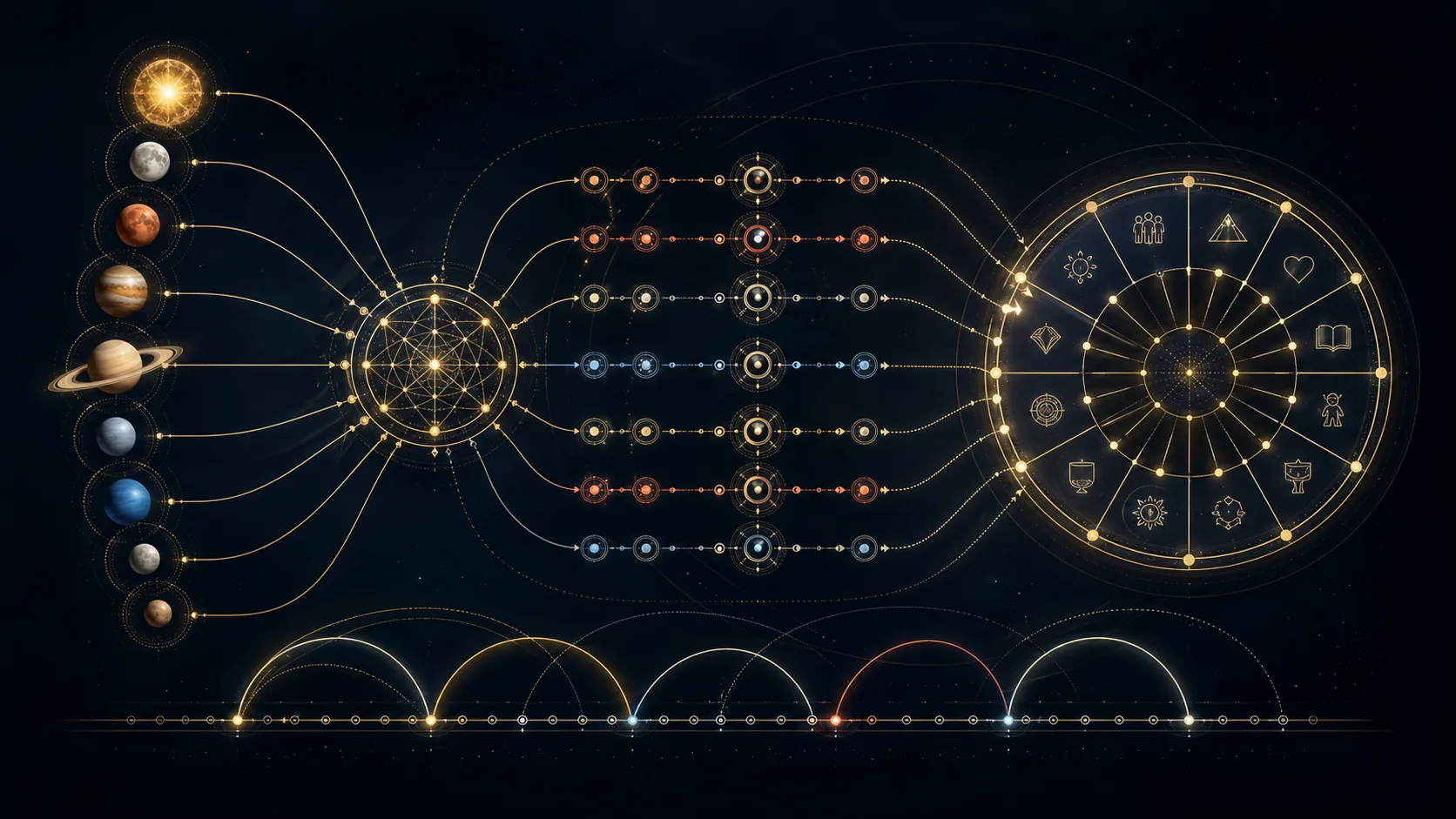
In KP Astrology, transits are not interpreted by sign placement alone. The central idea is simple, but powerful: a transiting planet gives the results of the house occupied by the star lord it is moving through. Because of that, a transit is not treated as a vague background influence. It becomes a precise timing mechanism that can bring already-promised events into visible life.
This is one of the reasons many students of KP feel that transit work becomes much more usable once the KP approach is understood properly. The same Saturn transit, Jupiter transit, or Rahu transit can coincide with very different outcomes for different people, even if those people share the same Moon sign or are born in the same year. The reason is that their natal star lords and house significations are different.
Transit search in KP is not about guessing that “something will happen” because a planet entered a sign. It is about finding whether the moving planet is activating the right natal significators at the right time, during the right Dasha-Bhukti, in a way that supports the event promised in the birth chart. When students first learn this, they often notice that many confusing transit predictions become much easier to verify against real life.
That is why transit analysis in KP is usually most useful when it is handled with a three-part mindset:
- Star transit principle: the planet delivers the results of the house(s) signified by the star lord it passes through.
- Dasha activation: transits can only activate what the running Dasha-Bhukti already supports.
- Planetary speed matters: slower transits create the broad life window, while faster transits help narrow the timing.
Once these three layers are understood together, transit reading becomes less about broad statements and more about locating the likely time window for marriage, job change, relocation, education, recovery, property events, or other life developments that the chart already supports.
The Star Transit Principle
This is the foundation of KP transit analysis. When a transiting planet moves through a nakshatra, it begins to carry the agenda of that nakshatra’s star lord. In practical terms, the transiting planet gives results connected to the houses signified by that star lord in the natal chart.
For example, if Saturn is transiting through Bharani Nakshatra, whose star lord is Venus, then Saturn’s transit is filtered through Venus. If natal Venus signifies the 2nd, 7th, and 11th houses, then Saturn may trigger events related to family, marriage, partnership, gains, savings, or social support. The event does not happen merely because Saturn is in a particular sign. It happens because Saturn is touching a star lord that is relevant to the native’s promise.
This is a major distinction from sign-only transit reading. In a sign-based approach, two people with the same Moon sign might receive similar-sounding predictions. In KP, that assumption is too broad. A person with natal Venus connected to marriage houses will experience Venus-linked transits very differently from a person whose Venus signifies obstacles, loss, or separative houses. The same transit can therefore be supportive for one person and merely transitional for another.
A simple real-life way to think about it is this: the sign is like the city a train enters, while the star lord is like the station that determines what the train unloads there. The train may be in the same city for everyone, but the goods it carries are different because the station authority is different. KP transit search focuses on that inner routing.
Students often find this especially helpful when transit patterns appear to “miss” obvious sign-based predictions. For instance, someone may hear that Saturn in a certain sign should bring a career shift, but nothing happens in their life. Later, when the star lord principle is checked, it becomes clear that Saturn was not moving through a star linked to career houses or the relevant Dasha lord. In another person, the same Saturn transit may coincide with a promotion, job transfer, or long-delayed responsibility because the natal significators were active.
This is also why transit reading in KP often feels more personal. The chart is not being asked, “What does the sign mean in general?” Instead, it is asked, “Which natal promises are being stimulated through the star lord, and are those promises ready to manifest under the running Dasha?”
How Different Planets Trigger Events
Every transiting planet has a different job in timing life events. Some planets set the wider background of change, while others bring sharper confirmation. This is useful because life rarely changes all at once in a neat, single-step way. Often there is a long phase of build-up, a middle phase of movement, and then a close-up trigger that makes the event visible.
In KP transit work, the slow planets are usually the most important because they describe the main window of possibility. Faster planets then act as smaller switches inside that window.
Here is the general role each planet often plays in transit timing:
- Saturn: sets the broad event window and often marks serious, lasting, or responsibility-heavy developments.
- Jupiter: refines the window and often supports growth, expansion, guidance, opportunity, or formal progress.
- Rahu/Ketu: often coincide with unusual, karmic, foreign, or disruptive developments, depending on the chart promise.
- Sun: narrows the timing to the month and often brings visibility, decision points, or authority-related developments.
- Moon: can sharpen the timing to the day and often reflects emotional response, movement, contact, or immediate unfolding.
To understand this more concretely, imagine someone expecting a job change. Saturn might first show that the career axis has entered a serious phase. Jupiter may bring an offer, interview success, or organizational support within that window. The Sun may then indicate the week or month when the offer is announced, while the Moon may match the exact day the email arrives or the call is made.
It is important not to force every transit into a dramatic event. Sometimes Saturn simply stabilizes an existing situation, especially if the chart does not promise a major change. In other cases, Jupiter may not produce an “amazing” event but may still bring a quiet improvement, helpful advice, a new connection, or a more favorable atmosphere. KP transit search works best when the nature of the event is matched to the promise of the chart rather than exaggerated.
Rahu and Ketu deserve special caution. They can show sudden movement, separation, unusual decisions, foreign links, or a sense that life is moving outside the normal pattern. But even here, KP does not treat them as random chaos-makers. They still deliver results through the houses and star lords they connect with. If the chart promises relocation, the nodes may help time it. If the chart does not promise it, the same transit may simply create restlessness or confusion without a clear external event.
A practical example may help. A native may be waiting for admission into a course abroad. Saturn could indicate the long wait, Jupiter could indicate the opportunity or approval, Rahu could show the foreign element, and the Sun/Moon could time the final announcement and travel preparations. None of these transits should be read in isolation. The event becomes clearer only when their meanings overlap inside the native’s Dasha.
Transit Through the Star of the Dasha Lord
One of the most important rules in KP transit analysis is that an event tends to manifest when a slow transiting planet passes through the star of the running Dasha or Bhukti lord. This is where transit work becomes especially practical. It links the external sky movement with the internal timing sequence already active in the chart.
Suppose a native is running Mercury Dasha. If Saturn transits through Ashlesha, whose star lord is Mercury, then Saturn activates Mercury’s agenda. If Mercury is connected to the relevant event houses in the chart, the transit can become a strong timing trigger. This does not mean Saturn itself “causes” the event in a standalone sense. Rather, Saturn becomes the messenger that presses the button of Mercury’s promise.
This is why transit search should not be treated as a replacement for Dasha analysis. The Dasha tells you what kind of event is available. The transit tells you when that event may surface. Without Dasha support, a transit may pass without producing a visible outcome. Without transit support, a Dasha may remain dormant or delayed.
For example, if someone is running a Dasha connected to marriage houses but there is no transit activation through the relevant star lords, the event may remain pending. Then, when Saturn or Jupiter finally transits through the star of the Dasha lord, the promise can become active. In real life, this may look like an engagement, meeting a prospective partner, family discussion, or formalization of a relationship.
A similar pattern may happen in career matters. A person may be in a good Dasha for promotion, but the actual result comes only when a transit touches the Dasha lord’s star and the relevant signification is activated. The person may then suddenly receive interview calls, performance reviews, or authority recognition that had not materialized earlier.
This timing idea is also useful for explaining why people sometimes experience a buildup before the event and not just one isolated moment. The Dasha can keep the topic alive for months or years, while transits create the timing spikes. One transit may open the door, another may push the door further, and the final fast-moving transit may let the event walk in.
To make this clearer, think about a native whose Bhukti lord signifies 10th and 11th houses. A Jupiter transit through that lord’s star may bring opportunities and gains, while a Saturn transit through the same star may delay, formalize, or make the process heavier but more durable. The event theme may be similar, but the experience and pace can differ.
This is why KP transit search is often done in combination with a careful reading of significators. When the Dasha lord, Bhukti lord, and transiting planet all converge on the same event houses, the timing becomes much more persuasive.
Confirming Events with Multiple Transits
Major events are rarely confirmed by one factor alone. In KP, strong event timing is usually seen when several layers support the same theme. That is why practitioners look for repeated confirmation from the slow and fast moving planets rather than relying on a single transit hit.
A common confirmation structure is:
- Saturn or Jupiter transiting the star of the Dasha lord
- Jupiter transiting the star or sub of the Bhukti lord
- Sun transiting the star of either Dasha or Bhukti lord, helping narrow the month
- Moon transiting through a relevant star, helping narrow the day
When these layers overlap, the chart becomes much more event-ready. Suppose a native is expecting a long-pending property decision. Saturn may show the seriousness and delay, Jupiter may indicate approval or growth, the Sun may bring the decision notice, and the Moon may correspond to the day of signing or communication. If only one of these is active, the event may remain weak or incomplete. If all are active, the timing becomes significantly stronger.
Another example is marriage. A chart may promise marriage through the Dasha sequence, but the exact moment of progress often requires transit support. Saturn or Jupiter may trigger the broader window. The Sun may bring the month when family conversations intensify. The Moon may align with the day of engagement, meeting, or important contact. If the chart supports marriage but the transits do not yet align, the native may simply remain in a waiting period.
For education-related events, the same logic applies. Admission, exam results, course changes, or academic travel often appear when the running Dasha connects to education houses and the transits activate those significators. A student may know they are “close” to a result for weeks before the final email arrives. In KP terms, that feeling often reflects the gradual activation of the Dasha by transit layers.
One important practical point is not to overstate the Moon’s role. The Moon can sharpen timing, but only if the broader promise exists. If the event is not supported by Dasha and slower transits, a Moon transit alone does not create destiny out of nothing. It only helps reveal the smallest time slice inside an already active pattern.
Similarly, the Sun may show a visible turning point, but it is rarely the core cause of a major life shift. It works best as a final timer. In the same way, a fast-moving trigger without slow-planet support is like ringing a doorbell on a house that is still locked. The sound is there, but the event has not yet become ready.
Why Transit Search Works Best With Natal Significators
Transit search becomes much more meaningful when it is tied to natal significators rather than treated as a standalone calendar exercise. In KP, the question is never just “Which planet is moving?” but “Which houses does that planet represent in the natal chart, and which planet’s star is it moving through?”
This is the core of why KP transit readings can become specific enough to be useful in daily life. A person’s Saturn transit may not matter much if Saturn is not activating important natal significators. Another person’s Saturn transit may be life-changing because Saturn is moving through the star of a planet connected to marriage, employment, or relocation.
Consider two people under the same Jupiter transit. One person’s natal Jupiter may signify 2nd, 5th, and 11th houses, so the transit may coincide with learning, gains, children-related matters, or family support. Another person’s natal Jupiter may signify more difficult or mixed houses, so the same transit may feel less like expansion and more like a necessary realignment. The sky movement is identical, but the chart signature is not.
This also explains why transit search should be paired with practical verification. Before assuming an event is coming, it helps to ask:
- Does the running Dasha support the event?
- Does the transiting planet move through a star linked to the Dasha or Bhukti lord?
- Do the natal significators point to the relevant life area?
- Are there supporting fast transits that narrow the window?
If the answer is yes across multiple layers, the event window becomes more credible. If the answer is mixed, the transit may show background pressure, preparation, or delay rather than a visible outcome.
This approach is especially helpful for people who have experienced “predicted” events that never happened. Often the issue is not that transit analysis failed. It is that the chart was read too broadly, without enough attention to the star lord, Dasha, or natal significators. KP reduces this problem by making the timing logic more specific.
Practical Examples of Transit Search in Real Life
To make the idea more concrete, here are a few everyday-style examples of how transits may function in KP astrology. These are not guarantees, but realistic illustrations of the method.
Example 1: Career movement
A native is in a Dasha-Bhukti sequence that supports career growth. Saturn transits through the star of the Dasha lord, while Jupiter later transits the star of the Bhukti lord. The person starts receiving serious discussions about promotion, additional responsibility, or a role change. The Sun transit during the same period may bring the official announcement, and the Moon transit may match the day they receive the message.
Example 2: Marriage or relationship formalization
A native is in a period connected to partnership houses. Saturn’s transit through a relevant star may create family pressure, delayed but serious discussion, or the need to define the relationship. Jupiter may open up support and agreement. The Sun may bring a public or formal step, while the Moon may coincide with a phone call, meeting, or decision that changes the direction of the relationship.
Example 3: Foreign travel or relocation
A chart may promise movement abroad through the Dasha, while Rahu transit adds the foreign or unconventional element. Saturn may show the paperwork, waiting, or practical burden. Jupiter may bring approval or expansion. A fast transit may then match the exact travel date. In real life this can feel like a long process that suddenly becomes real after months of waiting.
Example 4: Property, home, or family transition
A native may be planning a house purchase, renovation, or family move. Transits that activate 4th, 11th, or related significators can bring steps such as loan approval, document progress, negotiation, or relocation. Often the process is not dramatic at first; it begins with a quiet change in tone and ends with a concrete decision.
Example 5: Exam results or academic progress
A student may be in a supportive Dasha for education. Jupiter transiting the star of the Dasha lord may bring hope and confidence. A Sun transit may align with result publication. The Moon may mark the exact time the result is checked or shared with the family. The student may experience an anxious waiting period followed by a clear outcome.
These examples show why transit search is most useful when it is tied to actual life areas. People do not usually experience transits as abstract planetary movement. They experience them as calls, emails, meetings, approvals, delays, arrivals, departures, and changes in emotional atmosphere. KP gives you a way to connect those visible moments back to a timing framework.
How to Read Transit Windows Without Forcing Results
A mature transit reading avoids two common mistakes. The first mistake is ignoring a strong transit window and then being surprised when an event happens. The second is forcing an event where the chart does not yet support it.
In practice, the best approach is to treat transits as windows of probability. When the Dasha is active and the star lord transit is supportive, the window opens. The event may still depend on real-world choices, external conditions, and the chart’s own level of promise. KP does not replace life circumstances; it helps identify when circumstances are more likely to crystallize.
For example, if a person is in a job search period, a supportive transit window may coincide with active applications, interviews, networking, or a call from an old contact. If the person is not taking any action at all, the transit may still indicate readiness, but the external result may remain delayed. KP timing works best when it meets life halfway.
That is why transit search can be especially valuable for planning and self-awareness. It does not tell you to sit passively and wait for fate. It helps you recognize when efforts are likely to meet more responsive conditions. In some periods, it may be wise to push forward. In others, it may be better to prepare, wait, revise, or protect resources.
It is also helpful to remember that not every event is dramatic. Some transits bring internal shifts first: a change in mindset, a stronger sense of urgency, a conversation that clarifies priorities, or a feeling that something important is beginning to move. These may be the first signs of a larger event window forming.
Slow Planets and Fast Planets: The Timing Ladder
One of the most practical ways to understand transit search is to see it as a timing ladder. Slow planets create the broad rung, medium-speed planets refine it, and fast planets mark the immediate step.
Saturn often sets the longest and heaviest layer. It can describe commitment, pressure, delay, endurance, or permanent change. Jupiter tends to open growth and increase the likelihood that an event will become favorable or visible. Rahu/Ketu can add suddenness, irregularity, foreign links, detachment, or karmic reorientation. Then the Sun and Moon narrow the event into a month or day.
This ladder helps explain why many events are noticed in stages. A person may first sense that “something is building.” Later they notice a specific discussion, interview, or family conversation. Then an announcement or action follows. Finally, the exact day arrives. KP transit search can often identify these layers if the chart is read carefully.
It also explains why some major life changes seem to happen after a long wait. Saturn may prepare the ground for months or years, while Jupiter or Rahu marks the actual opening. If the native looks back later, the event often appears obvious in hindsight. Transit search aims to identify that opening before it becomes obvious.
Using the Transit Search Calculator
If you want to explore these patterns more systematically, the Transit Search Calculator can help you find when slow planets transit through your natal significator stars. That kind of search is especially useful when you already know the event area you are tracking, such as marriage, career change, relocation, education, or finances.
The calculator is best used as a timing aid, not as a final judgment by itself. A transit hit is more meaningful when you already know the natal promise and the active Dasha-Bhukti. In other words, the calculator helps you locate the time, but the chart still tells you what type of event is realistic.
Many people use transit search in a practical sequence:
- Identify the life area they want to understand.
- Check the running Dasha-Bhukti.
- Look for slow transit activation of the relevant star lords.
- Use Sun and Moon transits for narrower timing.
- Compare the result with actual life events.
That last step is especially important. Transit study becomes much stronger when you verify it against your own history. Looking back at an event such as a job offer, relocation, engagement, or financial turning point can teach you which transit combinations actually worked in your chart. Over time, this makes your transit search more precise.
When to Seek a Full Reading
Transit search can be useful for self-study, but some situations benefit from a deeper consultation. If you are facing an important decision or trying to understand a complex pattern, a full chart reading can help separate promise, timing, and practical meaning more clearly.
If you want a fuller transit-based prediction, you can book a consultation with I Navin. A consultation is especially useful when the same life area seems to be influenced by several overlapping factors, or when you want help interpreting whether a transit indicates a real event, a delay, or a background influence.
Transit work becomes most valuable when it is not treated as fortune-telling, but as timing analysis grounded in the natal chart. The aim is not to create certainty where life is still open. The aim is to identify when the chart is more likely to allow a promised event to surface.
Why KP Transit Search Feels So Specific
Many people come to KP after feeling that general transit astrology is too broad. That reaction is understandable. Sign-based transit predictions can sound relevant but still miss the exact nature of what happens. KP feels more specific because it reduces interpretation to a smaller chain of logic: transiting planet, star lord, natal signification, Dasha support, and event window.
When this chain is followed carefully, the timing becomes more readable. A person can begin to see why one month feels productive, why another month feels delayed, and why a third month brings sudden developments. The pattern may not make life predictable in a simplistic sense, but it can make life timing more understandable.
That understanding is often valuable on its own. It helps a person make better use of waiting periods, respond more calmly to sudden openings, and recognize that some delays are not denials but timing issues. In a practical sense, that can reduce confusion and help people plan with more awareness.
Transit search in KP is therefore not just about predicting events. It is about reading the rhythm of activation in a chart. Some periods are quiet. Some are preparatory. Some are decisive. The transits show where the rhythm is becoming active, and the Dasha shows whether the topic has been opened at all.
When both are read together, the sky becomes less mysterious and more useful.
Key Takeaways
- A transiting planet gives the results of the house occupied by its current star lord.
- Transits do not work in isolation; the Dasha-Bhukti must support the event.
- Saturn and Jupiter usually define the main timing window.
- Rahu and Ketu can bring unusual, foreign, or karmic developments when the chart supports them.
- Sun and Moon help narrow timing to the month and day.
- Multiple transit confirmations make a predicted event more credible.
- The transit search calculator can help locate likely timing periods, but the natal chart remains the foundation.
For deeper timing work, use the Transit Search Calculator and compare the results with the running Dasha-Bhukti. If you want help applying these principles to your own chart, you can book a consultation with I Navin.
Explore More from KP Astro Academy
Related Tools & Features
- Childbirth Selection Tool
- Birth Time Rectification Tool
- Ruling Planets Calculator
- Marriage Matchmaking Calculator
- Career & Education Finder
- Transit Search & Prediction
- Planetary Remedies Finder
- Free KP Kundli
- Daily Panchang Calculator
- Vedic Ephemeris Calculator
- Hora Chart Calculator
- Ashtak Varga Calculator
- KP Event Finder
- Personal Muhurat Finder
- Cusp Promise Calculator
- Bhav & Dasa Phal Predictions
- Dasha Promise Calculator
- KP Astrology Consultation
Further Reading
- Structured Kp Api Response Format For Developers
- Childbirth in KP Astrology: Promise, Delay, Denial, and Hope
- Birth Time Rectification Api For Astrology Products
- Gemstone Remedy Ecommerce Integration
- Saturn Transit Effects on Each House: A KP Astrology Perspective
- Transits Do Not Create Events. They Trigger What Is Already Promised.
- A Parent’s Manual to Choosing Activities, Environments, and Schooling Using KP Astrology
- The 7 Types of Meditation: Which One Fits Your Psychological Profile?
- Personal Muhurat Api For Premium Astrology Products
- How and Why Science Finally Agrees with KP Astrology: Why People With 1–5–9 in Their 10th CSL…
- KP Horary Astrology (Prashna) and the Role of Geographic Location
- Why Real Astrology Can’t Be Free, and Why Ethical Remedies Are Never for Sale
Loading article...