Āyakalai 64: Tamil Traditions of Holistic Skill-Building
Medium syndicated copy
This KP Astro Academy article is the canonical source. Medium copy: https://medium.com/@i-navin/%C4%81yakalai-64-tamil-traditions-of-holistic-skill-building-9d9d59674b76. Paste this canonical URL in Medium: https://kpastro.academy/blog/yakalai-64-tamil-traditions-of-holistic-skill-building
Āyakalai 64: Tamil Traditions of Holistic Skill-Building
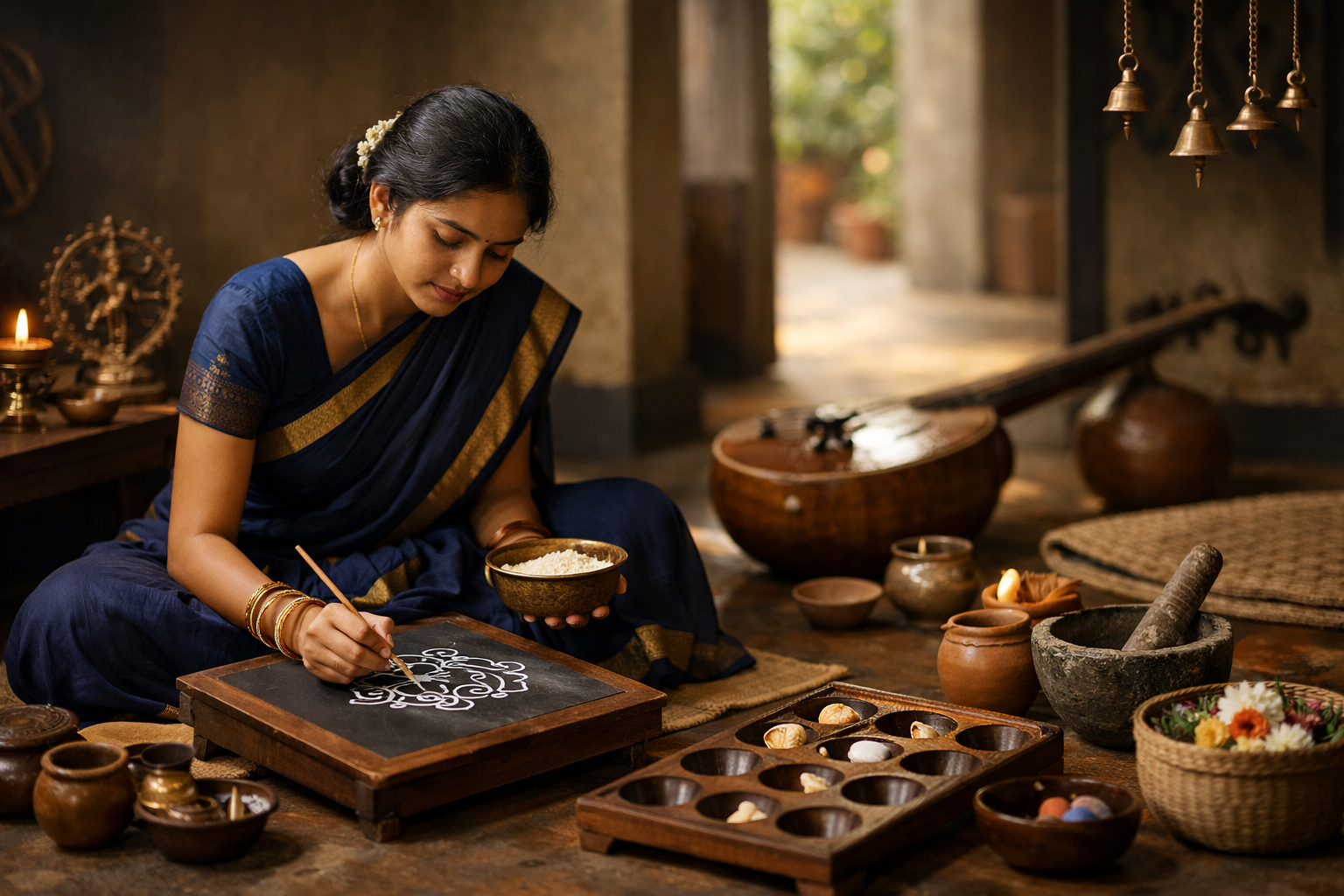
The Āyakalai 64 (ஆயக்கலைகள் அறுபத்து நான்கு) is an ancient Tamil framework that gathers 64 arts, crafts, and practical capacities into one wide view of human development. It is not simply a list of “hobbies” or an old catalogue of elite refinements. It reflects a way of seeing life in which skill, discipline, awareness, and culture are intertwined. In this worldview, a person becomes complete not by mastering only one narrow subject, but by learning to move gracefully across many dimensions of life: expression, craftsmanship, domestic responsibility, physical training, social conduct, and practical intelligence. Singing, dancing, carpentry, cooking, medicine, games, ornament-making, and storytelling all belong to the same educational universe because each trains a different part of the person.
In traditional Gurukula learning, this was not theoretical. Children learned by living alongside elders, observing work, repeating actions, helping in ordinary tasks, and gradually taking on more responsibility. The classroom and the household were not separate worlds. A kitchen could become a laboratory for measurement and patience. A courtyard game could become a lesson in strategy, turn-taking, and emotional control. A woven mat could become a lesson in rhythm, symmetry, and care. The phrase often used to capture this atmosphere is that “life itself was the laboratory.” That is the spirit of Āyakalai: not isolated instruction, but integrated growth.
In ancient Indian usage, a kalā was a cultivated skill that joined technique, taste, discipline, and intelligence. It was not enough to know how something was done; one had to refine how it was done. That distinction matters. A person could sing a melody, but a trained singer learned breath control, emotional expression, timing, and presence. A person could cook food, but a trained cook learned balance, timing, texture, serving, and the ability to adapt to what was available. A person could tell a story, but a trained storyteller learned pacing, memory, audience awareness, and moral nuance. The 64 kalās therefore represent a model of education that values competence and character together.
Modern readers sometimes approach the 64 arts as if they were ancient curiosities disconnected from today’s world. But the opposite is true. Their core insight is highly relevant now: human beings thrive when they are educated as whole persons. The Tamil tradition does not divide the mind from the hands, or knowledge from conduct, or creativity from practical life. It treats all of these as mutually reinforcing. That is one reason the Āyakalai 64 remains meaningful in conversations about childhood, cultural continuity, and future-ready education.
The 64 Kalās – Overview of Skills
Enumerating all 64 individually can become lengthy, but they naturally fall into broader categories. These categories are useful because they show the balance embedded in the system. Āyakalai is not one-dimensional. It does not privilege only one type of intelligence. Instead, it spreads attention across the many ways human beings learn and contribute.
- Performing and expressive arts: singing, playing instruments, dancing, acting, recitation, and related forms of performance. These arts develop memory, rhythm, emotional expression, and the ability to engage an audience.
- Visual and craft arts: painting, decoration, sculpture, weaving, jewelry-making, pottery, and other hand-based creations. These skills train the eye, the hand, spatial sense, patience, and aesthetic judgment.
- Language and storytelling: poetry, narrative, recitation, eloquence, and conversational skill. These develop vocabulary, listening, imagination, and cultural memory.
- Math and science-related knowledge: arithmetic, geometry, astronomy, mineral knowledge, herbal knowledge, and other forms of practical inquiry. These encourage logic, observation, and pattern recognition.
- Domestic life skills: cooking, arranging spaces, perfumery, floral work, care of plants and animals, and household management. These cultivate responsibility, attentiveness, and self-sufficiency.
- Physical training and strategy: riding, driving, wrestling, martial practices, puzzles, dice games, and strategy-based play. These build coordination, strength, competitive intelligence, and composure under pressure.
- Social and behavioral arts: etiquette, conversation, costume, body language, hospitality, and the art of pleasing. These refine empathy, timing, and social awareness.
What stands out is the integration. In many modern systems, one learns academic subjects separately from life skills. Here, the categories sit side by side. A child who learns to weave is not doing something “extra”; the act itself teaches concentration and design. A child who helps with cooking is not being interrupted from learning; the task itself teaches measurement, sequencing, and shared responsibility. A child who plays a game is not wasting time; the game may be teaching patience, memory, or strategy.
That spirit is visible in the way traditional Tamil culture often treated learning as participatory rather than passive. Children learned songs from elders, observed craftworkers, joined adults in preparation for festivals, and absorbed conduct through repeated exposure. There is a practical wisdom here: skills become stable when they are embodied. It is one thing to hear about a craft and another to feel the movement of the hands, the correction of the posture, the rhythm of repetition, and the small adjustments that only practice reveals. The Gurukula approach understood that knowledge grows through doing.
Consider a simple example from daily life. A child helping to prepare flowers for a home ceremony may learn how to sort, string, arrange, and handle delicate materials. That same activity quietly teaches pattern, color, care, coordination, and respect for ritual. If the child later listens to the elders explain why certain arrangements are used on special days, the lesson expands from craft into memory and cultural meaning. The ordinary becomes educational, and education becomes memorable because it is tied to life.
How the Tradition Sees Learning
One of the strongest ideas in Āyakalai is that no useful knowledge is “off limits.” The old framework does not place prestige only on literary or philosophical subjects. It includes making, moving, tending, caring, and performing. This is important because many children, even now, are naturally inclined to learn through touch, imitation, rhythm, and play. The Tamil tradition gives dignity to those ways of learning.
Another key idea is that skill-building shapes character. A person who practices patiently becomes more attentive. A person who repeats a song or crafts an object learns persistence. A person who participates in group arts learns to listen, wait, adapt, and cooperate. In that sense, the 64 kalās are not only about productivity. They are about formation. They cultivate temperament as much as technique.
This can be seen in the way children were expected to learn from masters. Apprenticeship was not rushed. A child watched, copied, received correction, and internalized habits over time. Even simple tasks were part of a larger rhythm of training. If a child helped with sweeping, arranging, or fetching, the point was not merely labor. The child was learning order, respect for space, and responsibility within a shared environment. If a child participated in singing or clapping games, the point was not merely amusement. The child was developing timing, memory, and group awareness.
The traditional frame also recognizes that different children reveal different strengths at different times. Some are drawn to movement, some to speech, some to pattern, some to making. A holistic curriculum leaves room for that variation. One child may be fascinated by drums and rhythm; another may quietly excel at threading beads or folding petals; another may love storytelling and dramatic play. The Āyakalai 64 makes space for all of them. Its breadth is one of its greatest strengths.
At the same time, it does not suggest that children should do everything at once or that every learner must become a master of all 64. Rather, it presents a cultural ideal of wide exposure. Children sample, observe, and gradually deepen. The point is not to create perfectionists but adaptable, grounded, and culturally literate people. In that sense, the system is remarkably modern in spirit.
Performing Arts, Memory, and Emotional Expression
The performing arts occupy a major place in the tradition because they bring together body, emotion, and community. Singing, dancing, acting, and recitation are not only forms of entertainment. They are ways of training awareness. Rhythm teaches timing. Melody teaches breath and listening. Dance teaches control, balance, and coordination. Drama teaches perspective, role-awareness, and the ability to inhabit another point of view.
For a young child, a simple folk song can be a full learning experience. The child hears language patterns, repeats sound, notices rhythm, and begins to anticipate what comes next. If the song is accompanied by clapping or movement, the body joins the memory. This is one reason songs and rhymes often stay with people long after direct instruction fades. They are stored not only as words but as embodied patterns.
Imagine a grandmother teaching a toddler a lullaby while rocking the child gently. The child may not understand every word, but the child learns the comfort of rhythm, the security of voice, and the pleasure of patterned language. Later, the same child may hear that song during a festival and remember family, place, and belonging. This is education at a deep level. It binds knowledge to emotion and relationship.
Drama and storytelling work in a similar way. A village performance or a simple home enactment can teach more than the words themselves. Children learn how characters differ, how conflict builds, how tone changes meaning, and how audiences respond. A child pretending to be a merchant, a farmer, a king, or a traveler is rehearsing social imagination. That rehearsal matters. It helps the child become more fluent in real social situations later.
Many families already use forms of this without naming it as education. A parent who tells a story about a clever rabbit, a brave child, or a greedy king is also teaching caution, humor, or ethical reflection. The child laughs, asks questions, and remembers. Āyakalai simply gives this everyday wisdom a larger framework.
Craft, Design, and the Intelligence of the Hands
The visual and craft arts remind us that intelligence is not only verbal. Hands can think. Eyes can measure. Materials can teach. When a child draws a kolam, shapes clay, strings flowers, folds cloth, or arranges objects symmetrically, the child is learning pattern, proportion, texture, and patience. These are not minor accomplishments. They are forms of disciplined attention.
Take weaving, for example. Even a simple weaving activity requires sequence, tension, repetition, and correction. If one thread is loose or misplaced, the whole pattern changes. That is a quiet lesson in precision and interdependence. It also teaches the child that beauty emerges through structure, not in spite of it. In the same way, jewelry-making or ornament creation teaches detail orientation and the ability to work with fine materials carefully.
Painting and decoration train the eye to notice relationships: color against color, shape against shape, empty space against filled space. A child learning to decorate a festival space is not merely making things “look nice.” The child is learning design logic. Why does one object sit here and another there? What is balanced? What feels crowded? What feels open? These are real aesthetic judgments.
In practical life, craft skills are inseparable from problem-solving. A household object may need repair. A mat may need to be made from local materials. A festive display may need to be assembled quickly with limited resources. A child who learns to make things with care and adaptability gains confidence. The child begins to see that useful beauty is possible without excess. That lesson is valuable in any era.
There is also something grounding in working with materials. Clay, fibers, wood, flowers, and simple tools have a way of slowing the mind. A child absorbed in arranging petals or shaping a toy can become calmer and more focused. Many teachers and parents notice this even without formal theory. The child who is restless during abstract talk may become deeply attentive when asked to cut, paste, fold, stack, or assemble. Āyakalai honors that reality by placing craft at the center of learning, not at the margins.
Language, Storytelling, and Cultural Memory
Language arts in the Āyakalai framework include far more than formal literacy. They include poetry, recitation, storytelling, and the art of speaking well. A child trained in these arts is not merely learning to pronounce words. The child is learning how words carry thought, tone, memory, and relationship.
In many Tamil households, stories travel from one generation to another in informal ways: bedtime tales, folktales, temple stories, proverbs, playful riddles, and family anecdotes. These are not casual decorations around “real learning.” They are real learning. Through stories, children absorb moral patterns, social customs, historical imagination, and a sense of belonging to a larger cultural world.
Consider a child hearing a story about generosity and greed. The child may not immediately articulate the lesson in abstract terms, but the emotional shape of the story remains. Later, when faced with a similar choice, that memory can return. Stories train moral sensitivity without reducing life to slogans.
Recitation also has a strong disciplinary function. To recite a poem or verse accurately, one must pay close attention to sound, order, and rhythm. Repeated practice strengthens memory. It also trains confidence in speaking aloud. A child who grows up reciting a rhyme in front of family members becomes less fearful of expression later in school or social life. This is one reason oral traditions remain powerful educational tools.
There is another practical benefit. Rich language exposure supports thinking itself. A child who has heard many stories and phrases can describe experiences more precisely, ask better questions, and understand more subtle distinctions. This matters in adulthood too. Good communication is not a decorative extra. It supports relationships, leadership, learning, and adaptation.
In a family setting, story-sharing can be wonderfully simple. A parent might describe how a grandmother managed a household during lean times, or how a festival was prepared in earlier years. The child learns history, resilience, and affection at once. Such stories often accomplish what lectures cannot: they make knowledge personal.
Math, Observation, and Practical Science
Although the Āyakalai 64 includes arts, it also embraces measurement, logic, and practical inquiry. Arithmetic, geometry, astronomy, herbal knowledge, and other forms of observation belong naturally within the system. This is one reason the framework should not be misunderstood as “only cultural” in a narrow sense. It is cultural in the richest sense: it recognizes that practical reasoning is part of life.
A child counting ingredients while helping in the kitchen is working with numbers in an embodied way. Measuring rice, dividing portions, or comparing shapes can introduce mathematical thinking without strain. A child observing how sunlight changes through the day, or how plants respond to water, is beginning to think scientifically. The lesson is not abstract first and practical later. The practical itself is the entry point.
One of the strengths of traditional learning is that it often began from direct observation. Children were encouraged to notice. How does a seed sprout? How do seasons change? Which leaf shape belongs to which tree? Which path is safest in the rain? These questions build attentiveness to the world. They teach that knowledge grows from careful looking.
Practical science in the old sense also included a respect for materials and consequences. If you use too much heat, food burns. If you mix certain materials carelessly, the result changes. If you plant at the wrong time, the crop may fail. The child who learns this early does not think of knowledge as a set of isolated facts. Knowledge becomes a relationship with reality.
Today, this approach still matters. A child who learns to notice patterns in the world develops resilience and flexibility. Whether that child becomes a scientist, artist, farmer, engineer, or entrepreneur, the habit of observation remains valuable. The Āyakalai 64 encourages exactly that: a mind that watches closely and learns from what it sees.
Domestic Life as Education
One of the most underrated parts of the Āyakalai tradition is its inclusion of domestic life skills. Cooking, care of spaces, perfumery, floral arrangement, tending plants, and understanding the rhythms of home are not treated as secondary. They are part of the educational field because they are part of human life.
Cooking is a particularly rich example. A child helping to wash vegetables, sort ingredients, stir a pot, or arrange serving vessels learns more than recipe steps. The child learns sequence, hygiene, patience, and the connection between effort and nourishment. There is also social learning: food is often prepared for others. The child discovers that care can be made visible through service.
Similarly, arranging a room for guests or preparing a space for a family event teaches order and hospitality. These are not merely “chores.” They are practices of attention. A child who learns to set things in place begins to understand how environments affect mood and relationships. A tidy, welcoming space communicates respect. A well-prepared meal communicates love. A carefully arranged flower display communicates celebration. These are subtle but important lessons.
Plant care and animal care also matter. When a child waters a plant consistently, the child learns the link between continuity and growth. When a child observes an animal’s needs, the child learns empathy and responsibility. The lesson is not sentimental. It is practical and enduring. Living things require attention over time.
Families often underestimate how much children learn from these tasks because the tasks seem ordinary. Yet the ordinary is exactly where habit forms. Āyakalai recognizes that daily life is a teacher. A culture that dignifies these tasks dignifies the people who do them and the children who learn from them.
Physical Training, Games, and Strategy
Physical training is another major dimension of the 64 kalās. Riding, driving, wrestling, martial arts, and other forms of movement build strength, balance, alertness, and courage. But the tradition also includes games, puzzles, dice, and riddle-based play, showing that strategy and physicality are not separate domains. They often work together.
Play is one of the most natural ways children learn. A child running, chasing, balancing, jumping, or role-playing is testing abilities and limits. Such play builds coordination, but it also teaches turn-taking, risk assessment, and social regulation. Children learn when to push, when to wait, when to yield, and when to lead.
Imagine a group of children playing a local game in a courtyard. One child organizes rules, another argues a point, another laughs after losing, and another tries again. In this moment, a rich lesson is taking place. The children are learning how to hold competition without breaking relationship. They are learning how to accept outcome, negotiate fairness, and recover from frustration. Those are important life skills.
Traditional games like pallankuzhi, kabaddi, kite flying, or other local forms of play often combine memory, calculation, movement, and teamwork. They are not merely diversions. They are training grounds for social and mental agility. Likewise, riddles and puzzle-like activities exercise flexibility of thought. A child who learns to think laterally, to see multiple possibilities, becomes more adaptable in school and in life.
Martial and physical disciplines also teach more than force. They teach discipline, posture, timing, and respect. Well-led physical training is not about aggression alone. It is about control. A person who learns movement responsibly learns that power without discipline is incomplete. That principle extends beyond the body into character.
The beauty of the Āyakalai view is that it does not separate “serious learning” from play. It treats play as one of the serious forms of learning. That insight fits perfectly with what many parents and educators observe today: children learn best when they are active, engaged, and emotionally safe.
Social Conduct, Etiquette, and the Art of Living with Others
The Āyakalai 64 also pays close attention to social and behavioral arts. Conversation, etiquette, attire, body language, and hospitality are all part of skill-building. This may seem surprising at first, but it makes perfect sense. A person does not live alone. To live well, one must know how to meet others well.
Conversation is an art because speaking is not only about transmitting information. It is about timing, tone, responsiveness, and respect. A child who learns to greet guests, listen carefully, and respond politely is learning to participate in community life. These small practices shape social ease. They reduce friction and build confidence.
Etiquette too is more than outward form. It expresses care for shared space. How do you receive an elder? How do you enter a room? How do you wait your turn? How do you share food? How do you speak without interrupting? These habits matter because they make community possible. They are not superficial. They are the patterns that allow intimacy and order to coexist.
Body language and presentation are also included because human beings communicate constantly, even without words. A child learns whether a posture is open or closed, whether a face is attentive or distracted, whether a gesture is welcoming or discouraging. This awareness helps in family life, school life, and later in work life. It also supports emotional intelligence, because people who notice body language often become more sensitive to the needs of others.
Hospitality is another major social art. Welcoming others, offering water, food, seating, and respectful attention are deeply rooted cultural practices. In many Tamil settings, hospitality is inseparable from dignity. A child who helps prepare for visitors learns that generosity is not only about grand gestures. It is about making others feel acknowledged.
This social dimension may be one of the most practical parts of the entire framework. Many adult difficulties arise not from lack of technical talent, but from weak communication, poor adjustment, or inability to cooperate. Āyakalai addresses that early by making social skill a visible part of education.
Why the Tradition Fits Early Childhood So Well
The Āyakalai 64 maps especially well to early childhood because young children naturally learn through multisensory experience. Before formal schooling becomes central, children explore through movement, repetition, imitation, sound, image, and play. This is exactly the space where the traditional arts thrive.
A young child who sings, claps, tells stories, draws, builds, imitates adults, and plays group games is already participating in many of the kalās in simple form. A child does not need advanced theory to begin. The entry point is joyful engagement. The deeper learning comes through repetition and guided participation.
Consider a home where a child helps with chapatis in the kitchen, listens to an elder narrate a folk tale, joins siblings in a game of catching, and later arranges marigold petals for a small festival altar. That single day may contain language, math, movement, aesthetics, responsibility, and social bonding. The child is learning across domains without feeling divided between “work” and “study.”
That is one reason the Āyakalai idea aligns so well with modern early education principles that value play-based, experience-rich learning. Children are not miniature adults to be filled with facts. They are whole beings developing through interaction. A curriculum that respects that reality is likely to be both humane and effective.
Traditional Tamil methods also understood something else that remains true today: children need culture as well as skill. Learning is not only about individual achievement. It is also about being initiated into a world of shared meanings, songs, rituals, stories, and ways of life. The 64 kalās help children enter that world with confidence.
Āyakalai and the Post-AI Future
The relevance of the Āyakalai 64 becomes even clearer in a world shaped by automation and artificial intelligence. As routine tasks become easier to automate, the human strengths that remain essential are the very ones this tradition nurtures: creativity, adaptability, communication, emotional intelligence, and cross-domain thinking.
Machines can process data quickly, but they do not replace the person who can design, empathize, improvise, or relate different forms of knowledge to one another. A child trained only in narrow task performance may struggle when contexts change. A child exposed to many forms of skill, on the other hand, learns how to transfer attention and adjust to new situations.
Think of a young person who has grown up painting, playing music, helping in the kitchen, organizing family events, and participating in games of strategy. That young person has likely practiced concentration, flexibility, and collaboration in varied settings. Those habits are useful in any future profession. Even when a specific tool changes, the underlying capacities remain.
Emotional and social intelligence are especially important. Drama, music, storytelling, and conversation train people to recognize feeling, navigate ambiguity, and work with others. These are not optional extras in the future workplace. They are core strengths. Likewise, creative thinking emerges more readily in people who have learned to move between domains. A person who has both manual and imaginative experience may find better solutions than someone trained only to follow instructions.
Physical dexterity and spatial reasoning also continue to matter. Not every future job will be purely digital. Many fields still require precise movement, design sensitivity, and the ability to handle tools or materials responsibly. Whether in healthcare, design, crafts, infrastructure, or service work, embodied intelligence remains valuable.
Seen this way, the Āyakalai 64 feels less like a relic and more like a wise preview of future needs. It teaches the whole child, and the whole person is exactly what changing times require.
Practical Ways to Revive Āyakalai at Home
Families do not need to recreate a historical gurukula to benefit from this tradition. The underlying ideas can be brought into ordinary routines in practical ways. The key is not complexity. The key is consistency, warmth, and a willingness to treat daily life as a learning field.
One simple place to begin is with music and rhyme. Parents and caregivers can sing songs in Tamil and other languages, clap patterns, and make small movement games. A child may first respond by imitation, then by anticipation, then by invention. That progression is itself a form of learning. Music can also be tied to cleanup time, transition time, or travel time, making routines feel shared rather than imposed.
Storytelling is another powerful entry point. Bedtime stories, family stories, and local folktales can become regular rituals. Even a five-minute story can build memory and emotional closeness. A parent might ask the child to retell the story in their own words, draw a scene from it, or act it out with toys. These small extensions deepen comprehension without pressure.
Cooking together is one of the richest home-based activities. Children can wash vegetables, sort ingredients, measure, knead, stir, and observe timing. Such moments teach practical math and patience while also creating family connection. A child who feels trusted with age-appropriate kitchen tasks often gains pride and responsibility.
Craft activities do not have to be expensive. Paper folding, clay shaping, stringing beads, drawing kolam patterns, and making simple toys from household materials all count. The goal is not polished output but hands-on attention. Children benefit from seeing that beautiful and useful things can be created from ordinary materials.
Movement matters too. Outdoor play, dance, simple yoga, running games, balancing games, and traditional sports help the body mature happily. A child who moves freely often thinks more freely as well. Physical confidence supports emotional regulation and social ease.
Most importantly, adults should participate. Children learn powerfully by watching respected people enjoy learning. When a parent sings, kneads dough, tells stories, or joins a game, the child sees that skill-building is a lifelong practice, not something reserved for school alone.
Practical Ways to Bring Āyakalai into Schools
Schools can also benefit from the spirit of Āyakalai by making learning more integrated. A classroom does not have to choose between academic rigor and playful creativity. It can include both. In fact, children often learn more effectively when movement, story, making, and inquiry are woven into the day.
A balanced schedule might include story circles, music, art stations, outdoor play, counting games, and simple investigations of the world. Teachers can build themes around local festivals, seasons, plants, food, animals, or community life. Such themes allow language, science, math, and art to meet naturally.
Hands-on corners can be especially effective. One corner might have blocks, puzzles, and pattern materials. Another might include crayons, clay, and paper. Another might invite role-play, dress-up, or storytelling. Another could involve simple local crafts such as weaving, kolam work, or model-making. These spaces allow different kinds of intelligence to show themselves.
Schools can also invite artists, craft workers, cooks, gardeners, storytellers, and community elders to share their skills. Children often remember these experiences vividly because they connect learning to real people. When a potter explains clay, or a musician demonstrates rhythm, or a gardener shows how to care for plants, children see knowledge embodied.
Technology can support this if used wisely, but it should not replace active doing. A song video in Tamil, a simple coding game, or a digital story can be helpful supplements. The deeper principle remains the same: children should participate, make, move, speak, and explore.
Schools that adopt this spirit often notice increased engagement. Children who struggle in purely verbal settings may flourish in a mixed environment. Children who are shy may speak more readily through performance or storytelling. Children who are restless may find focus through making or movement. The whole point is to widen the doors through which learning enters.
Community Life and the Revival of Shared Learning
Āyakalai is not only for homes and schools. It is also a community framework. Festivals, local gatherings, temple events, libraries, village halls, and cultural programs can all become spaces of skill-sharing. This matters because children often learn most deeply in environments where learning feels social and meaningful.
Community festivals already contain many of the 64 arts. There are songs, decorations, costumes, food preparation, storytelling, group participation, and often games or performances. A child helping with a festival kolu, for example, may be arranging objects, listening to stories, asking questions, and participating in family memory all at once. The event is joyful, but it is also formative.
Summer camps or neighborhood play programs can rotate children through different experiences: a story corner, a music corner, a craft corner, a movement corner, and a games corner. Such simple design can expose children to wide skill sets without pressure. Children who might not encounter certain arts at home can discover new interests through community spaces.
Local libraries and cultural centers can also host intergenerational workshops. Grandparents might teach folk songs or stories. Craftspeople might demonstrate useful household or decorative skills. Youth groups might organize traditional games. Parents and children can learn together, which often strengthens both participation and respect.
In many places, the revival of such community learning would not require elaborate infrastructure. It requires intention. The value of Āyakalai is that it makes ordinary local resources visible as educational resources. A tree becomes a storytelling place. A courtyard becomes a game area. A kitchen becomes a science space. A festival becomes a school of culture.
Conclusion: A Whole Child Vision for Today
The enduring power of the Āyakalai 64 lies in its wholeness. It does not reduce education to performance on tests, nor does it isolate knowledge from living. It understands that a person grows through many channels: song, speech, handwork, movement, observation, service, play, and social interaction. It also understands that these channels shape not only skill, but character.
That is why the framework remains so valuable. It offers a timeless reminder that learning should be joyful, practical, cultural, and integrated. It invites parents, teachers, and communities to stop treating creativity as a luxury and life skills as secondary. It shows that a child can learn arithmetic while cooking, history while listening to stories, social intelligence while playing games, and aesthetics while arranging flowers or drawing patterns.
In a world that often pushes specialization too early, Āyakalai offers balance. In a world that often separates body from mind, it restores unity. In a world that often prizes speed over depth, it honors patience. And in a world increasingly shaped by AI and rapid change, it reminds us that the most durable human strengths are those that connect intelligence with sensitivity, and skill with spirit.
For families, schools, and communities looking for a grounded path forward, the 64 kalās offer more than heritage. They offer a living philosophy of education. They suggest that the best preparation for the future is not narrow training alone, but a broad, culturally rooted, deeply human formation that helps children become capable, kind, and adaptable people.
That is the promise of Āyakalai: not just to produce skilled individuals, but to nurture whole human beings.
Sources: Historical lists of the 64 Āyakalai appear in Tamil literature, including references in classical works and later scholarly discussions. Modern scholarship on India’s 64 Kalā curriculum and Gurukula methods provides context for understanding the holistic learning model. Educational research on play, music, storytelling, hands-on crafts, movement, and games supports the view that integrated learning strengthens language, cognition, and social development. National early-learning frameworks likewise emphasize songs, rhymes, active learning, and child-centered exploration. Finally, future-of-work discussions consistently highlight adaptability, creativity, communication, and emotional intelligence as central human capacities in a changing world. All cited ideas are woven into the discussion above.
Explore More from KP Astro Academy
Related Tools & Features
- Childbirth Selection Tool
- Birth Time Rectification Tool
- Ruling Planets Calculator
- Marriage Matchmaking Calculator
- Career & Education Finder
- Transit Search & Prediction
- Planetary Remedies Finder
- Free KP Kundli
- Daily Panchang Calculator
- Vedic Ephemeris Calculator
- Hora Chart Calculator
- Ashtak Varga Calculator
- KP Event Finder
- Personal Muhurat Finder
- Cusp Promise Calculator
- Bhav & Dasa Phal Predictions
- Dasha Promise Calculator
- KP Astrology Consultation
Further Reading
- Childbirth in KP Astrology: Promise, Delay, Denial, and Hope
- Gemstone Remedy Ecommerce Integration
- Live Ruling Planets vs Birth Chart Ruling Planets: A KP Astrologer's Guide
- What is Birth Time Rectification in KP Astrology? A Complete Guide
- Ashtakvarga System: Measuring Planetary Strength in Your Kundli
- The Neuroscience of Stillness: How Meditation Physically Changes Your Brain
- Job or Business? The KP Way to Stop Choosing Blindly
- Birth Time Rectification Elemental Theory B2B Astrology
- Timing Your Promotion and Job Change Using KP Dasha and Transits
- How and Why Science Finally Agrees with KP Astrology!
- Vastu Shastra and KP Astrology: Using Geographic North for Building Orientation (Diya Drishti Method)
- Stop Calling It Astrology When It Is Just Entertainment
Loading article...