How to Read a KP Birth Chart: Planets, Houses, and Sub-Lords Explained

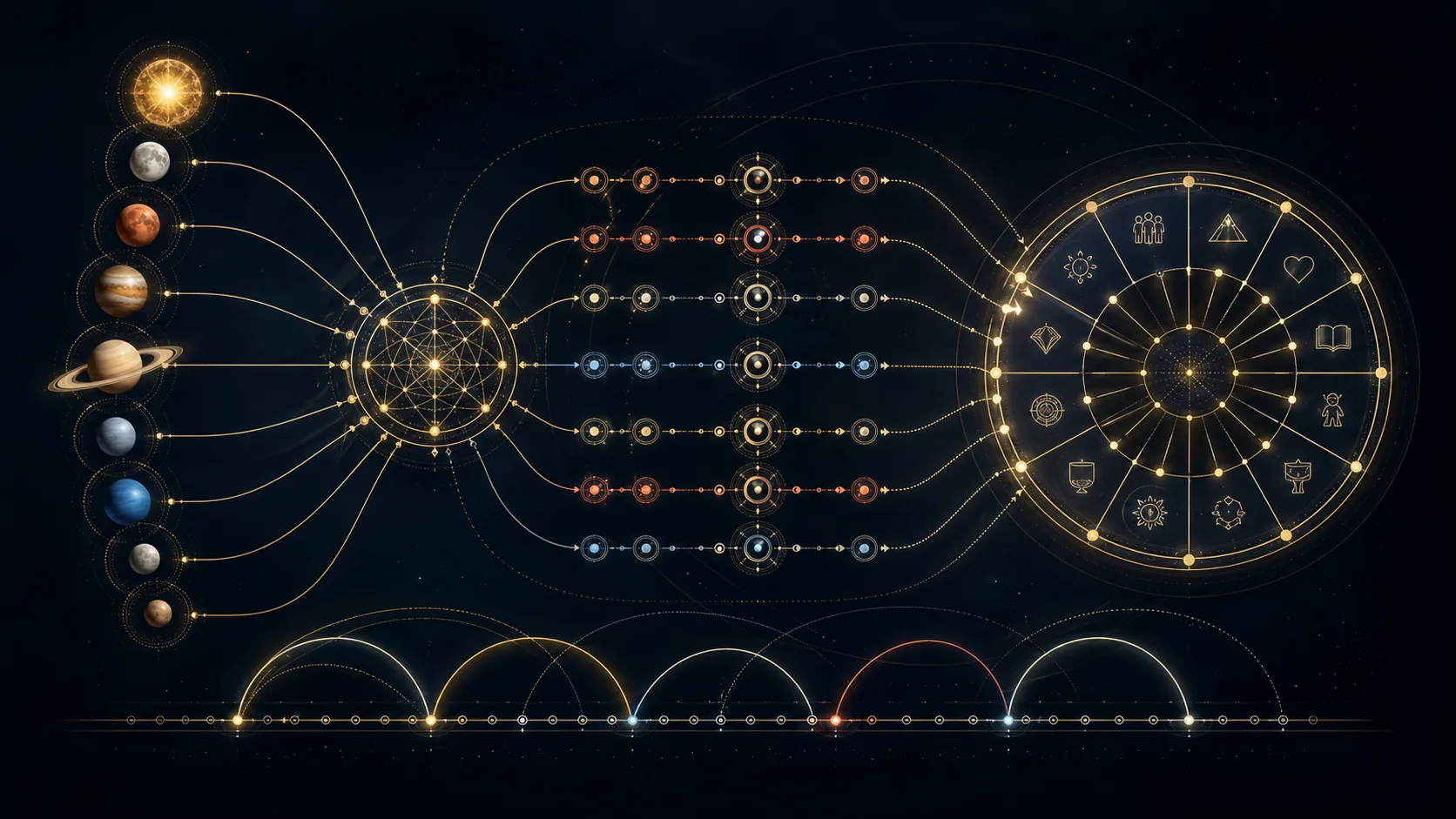
Reading a KP birth chart can feel intimidating the first time you open it. There are house cusps, planets, star lords, sub-lords, significators, and timing factors all appearing at once. Yet once the structure is clear, the chart becomes much easier to work with. A KP chart does not ask you to memorize random rules; it asks you to follow a sequence: identify what is acting, where it is acting, and how the result is likely to unfold.
That is why beginners often find KP practical. Instead of guessing from one placement alone, you examine a chain of connections. A planet may look strong by sign, but if its sub-lord denies the relevant house matters, the outcome changes. A house may show promise, but if the connected significators are weak, the promise may remain incomplete. This layered approach is what makes the system useful for specific questions like career growth, marriage, education, foreign travel, or settlement.
Imagine two people asking the same question: “Will I get a job soon?” One chart may show strong career indicators through the 10th and 11th houses, yet the timing may still depend on the Dasha-Bhukti lords and the sub-lords connected to service and gains. Another person may have a powerful Jupiter or Mercury, but if those planets do not signify the relevant houses, the promise is weaker. KP forces you to separate general potential from actual event triggering.
In this guide, we will break the chart into three essential layers:
- Planets: the actors or agents in the chart
- Houses: the life areas where results are experienced
- Sub-lords: the deciding layer that confirms or denies the outcome
If you want to compare this method with other systems, you may also find it useful to read KP Astrology vs Vedic Astrology. If you are not yet confident about chart accuracy, especially birth time, the article on birth time rectification and geographic coordinates will help you understand why precision matters so much in KP.
The 9 Planets in KP Astrology
KP uses the same nine planets as other Indian astrology systems: Sun, Moon, Mars, Mercury, Jupiter, Venus, Saturn, Rahu, and Ketu. The difference is not in which planets are used, but in how they are read. In KP, every planet contributes to results based on the houses it signifies through the star lord and sub-lord relationships.
That means a planet is never judged only by its sign placement. A well-placed planet can still produce mixed results if it signifies difficult houses. A planet placed in a difficult sign can still support a positive outcome if it strongly connects to the right houses through its star and sub-lord chain. This is one reason KP readers avoid making broad statements from a single factor.
Below is the common natural significator meaning of each planet. These are the baseline qualities, useful as a starting point before house analysis begins.
- Sun: authority, government, father, vitality, leadership
- Moon: mind, emotions, mother, public life, responsiveness
- Mars: courage, action, property, siblings, initiative
- Mercury: communication, logic, business, education, trade
- Jupiter: wisdom, expansion, children, law, guidance
- Venus: love, beauty, marriage, comfort, luxury
- Saturn: discipline, delay, duty, work, endurance
- Rahu: obsession, foreign matters, unusual events, sudden shifts
- Ketu: detachment, spirituality, research, past karma, withdrawal
These meanings matter because they describe the planet’s natural style. For example, Mercury is often involved when a chart shows writing, teaching, business negotiation, sales, or technical learning. Venus frequently comes up in questions about relationships, attraction, artistic work, or comforts. Saturn may indicate pressure and delay, but it can also support stable long-term achievement when linked to the right houses.
A realistic example helps. A student preparing for an entrance exam may have Mercury and Jupiter as important significators. Mercury can show study, learning, and memory of facts, while Jupiter can indicate higher knowledge and academic support. If those planets also connect to the 5th, 9th, and 11th houses, the chart is much more encouraging. If the same planets are tied more strongly to the 6th house, the person may still succeed, but only after effort, competition, and stress.
Another common example is relationship analysis. Venus is naturally important, but Venus alone does not confirm marriage. In KP, marriage needs house connections, especially those related to partnership, fulfillment, and social union. A Venus that is active for love but not supportive of the relevant house pattern may show attraction without completion. This is why KP users learn to look beyond natural significations and focus on the full chain.
The 12 Houses in KP
Houses, or bhavas, are the areas of life where planetary results are experienced. In KP, house cusps are calculated through the Placidus system, which allows a more exact division of the chart than simple equal-house style approaches. Since KP is a timing-oriented system, the cusp is central. A small change in birth time can alter the cusp lord, sub-lord, and final result.
Each house has a specific life theme:
- 1st House: self, body, health, personality, longevity
- 2nd House: wealth, family, speech, food, savings
- 3rd House: courage, communication, siblings, short travel, initiative
- 4th House: home, mother, education, property, vehicles
- 5th House: intelligence, children, creativity, romance, merit
- 6th House: disease, debt, competition, service, enemies, obstacles
- 7th House: marriage, spouse, partnerships, business alliances
- 8th House: sudden events, obstacles, transformation, inheritance, longevity
- 9th House: fortune, dharma, higher learning, father, long-distance travel
- 10th House: career, profession, status, authority, responsibility
- 11th House: gains, income, networks, desires, fulfilment
- 12th House: expense, loss, sleep, isolation, foreign lands, moksha
The house meanings are easy to memorize, but KP uses them in a practical way. When someone asks about marriage, the 7th house is obvious, but a complete answer often requires the 2nd and 11th houses too, because they support family formation and fulfillment of desire. For foreign settlement, the 12th house is important, but it is not read alone; other houses may show travel, relocation, career reasons, or connections with life abroad. For career, the 10th house matters most, but the 6th and 11th often show service, competition, and gains.
Consider a young professional who has been applying to companies for months. If the 10th house is active, the 6th house shows effort and competition, and the 11th house shows gains, the chart often reflects the pattern of repeated applications leading to an offer. Another person may have the same 10th house activation but no supporting 11th house connection, which can show interviews and visibility without final selection. In practice, this is why KP readers rarely stop at one house.
There is also an important habit in KP chart reading: do not interpret houses in isolation from the question. The same 7th house that shows marriage in one context can show business partnership in another. The same 12th house can indicate expenditure in one matter and foreign residence in another. Meaning becomes sharper when it is linked to the specific query.
How the Sign Lord, Star Lord, and Sub-Lord Work Together
This is the part of KP that makes it distinct. Every planet and every cusp is interpreted through layers. The first layer is the sign lord, which gives the broad background. The second layer is the star lord, which describes the source of activation. The third layer is the sub-lord, which delivers the final decision.
- Sign Lord: rules the zodiac sign and sets the general environment
- Star Lord: rules the nakshatra and shows which house matters are being activated
- Sub-Lord: rules the sub-division and confirms whether the result is ultimately supportive
In simple terms, the sign lord gives flavor, the star lord gives direction, and the sub-lord gives the verdict. That is why KP readers repeat the principle: the star lord promises, but the sub-lord decides.
Here is a practical way to think about it. Suppose a cusp for marriage is connected to a planet that is a strong star lord for the 7th house. That creates promise. But if the sub-lord of that cusp connects more strongly to denial houses or weaker outcomes for the question, the event may not materialize in the expected way. The chart may still produce a relationship, but not the final form the native was expecting. KP is careful about this distinction.
Imagine a woman who wants to know whether a relationship will turn into marriage. She sees Venus placed strongly in her chart and assumes the answer is yes. A KP reading would go further. If Venus is only naturally strong but the relevant houses are not supported, the relationship may remain affectionate but unstable. If, on the other hand, Venus, the 7th cusp, and supporting significators all line up through the right house connections, the promise becomes much clearer.
The same logic works for business. A person may have Mercury strongly placed, suggesting communication and commerce. But if the sub-lord of the 10th cusp does not support profession or if the 2nd and 11th house links are weak, then the business may stay in planning stage. One common real-life pattern is that a person is excellent at networking and ideas, yet actual income remains inconsistent. KP helps separate capability from realization.
The Significator Table: The Practical Heart of KP
The significator table is one of the most important tools in KP. It lists which planets signify which houses, usually arranged by strength. This is where the theory becomes usable in prediction. Instead of asking whether a planet is good or bad in a general sense, you ask: Which houses does this planet signify?
If you want to know whether a result is promised, you first identify the houses relevant to the question. Then you check whether the active planets, especially the Dasha-Bhukti lords, are among the significators of those houses. This is how a KP analysis becomes systematic instead of vague.
For example, if someone asks, “Will I get married?” the relevant houses are often 2, 7, and 11. The 7th house shows partnership, the 2nd shows family formation, and the 11th shows fulfillment of desire. If the running period lords signify these houses strongly, the marriage potential is much better. If the active lords signify mostly the 6th, 8th, or 12th houses, the period may bring delays, disputes, expense, or distance instead.
Take another example: “Will I change jobs this year?” A KP analysis would typically look at the 10th house for profession, the 6th for service and job environment, and the 11th for gains. If the current period supports these houses, a switch may happen. If the period activates only the 12th house, the person may experience leaving, loss, or separation without a clear replacement yet. The timing question is answered by the exact mix of significators.
This also explains why two people with similar planetary placements can have very different outcomes. One chart may have multiple planets signifying the same supportive houses, creating repeated activation. Another may have scattered significations, producing mixed or delayed results. The significator table helps you see that pattern quickly.
A Practical Way to Read a KP Chart
For beginners, it helps to use a repeatable method. Instead of scanning the whole chart randomly, move through the chart in a fixed sequence. That keeps the interpretation disciplined.
- Start with the question. Identify which houses matter for that topic.
- Check the cusps. See which planets are the cusp star lord and sub-lord.
- Study the Dasha-Bhukti lords. These are often the timing triggers.
- Look at significations. Confirm whether the active planets signify the required houses.
- Judge the sub-lord carefully. It can confirm, delay, modify, or deny the expected result.
Let us walk through a simple scenario. A person asks about higher education abroad. In KP, the 9th house can show higher learning, the 12th house can show foreign connection, and the 3rd or 6th may show effort, paperwork, tests, or competition. If the running period lords connect to these houses, the chance of study abroad becomes more realistic. If only the 9th house is active but the 12th is not, higher education may happen but not necessarily overseas. If the 12th is active without the educational houses, the native may travel but not for study.
Another example involves property. A family may want to buy a house and sees a strong 4th house. But in KP, you also look at the 2nd house for savings and the 11th for gains. The 4th house alone can show desire or intention to own property, yet the final result depends on whether the money and fulfillment houses are also involved. Many people discover that the chart shows “house-related matters” but not immediate purchase, and this distinction prevents unrealistic expectations.
Why Accurate Birth Time Matters So Much
KP is sensitive to birth time because cusp positions change quickly. Even a small error can alter the sub-lord and shift the interpretation. That is why precise birth time is not a minor detail in this system; it is one of the foundations of reliable reading. If the chart is off, the significator table can also be off, and the prediction may change completely.
This is where rectification becomes important. If a person only knows an approximate time, the chart may need adjustment using life events. For example, the timing of marriage, first job, relocation, childbirth, or a major career change can help narrow the correct birth time. If you want a deeper explanation of this process, read KP birth time rectification and geographic coordinates.
It is also why the same chart should be prepared carefully before interpretation. A clean chart with correct place, time, and coordinates makes house cusps and sub-lords meaningful. Without that, the rest of the analysis becomes less dependable. Beginners sometimes blame the method when the real issue is data accuracy.
A practical example: a person born near midnight may be given a time that falls on one side of a cusp, but the actual event pattern matches the other side. In KP, that difference can affect whether a question about marriage, foreign travel, or career is read as likely or delayed. This is not a flaw in the method; it is a reminder that exact input matters.
How KP Uses Houses for Real-Life Questions
Once you understand the chart structure, you begin to see how the same principle applies across different life areas. KP is especially useful because it can be applied to very specific questions. Below are a few common examples.
Marriage: Look at the 2nd, 7th, and 11th houses, and check whether the running periods and cusp sub-lords support commitment, family formation, and fulfillment. A relationship may already exist, but marriage often needs stronger confirmation through the correct house chain.
Career: The 10th house is central, with support from the 6th and 11th. The 6th can show service, competition, and daily work routine, while the 11th can show gains and achievement. A chart may show job opportunities but still delay promotion if the supporting houses are weak.
Foreign travel or settlement: The 12th house is important, along with related houses depending on the exact question. If you want to understand foreign settlement versus mere foreign desire, see this article on foreign settlement or foreign desire in KP astrology.
Education: The 4th, 5th, and 9th houses are commonly examined. The 5th often indicates intelligence and learning, the 9th higher knowledge and guidance, and the 4th stable foundational education. If the chart shows repeated changes in course or hesitation, the house pattern often reflects that.
Business: The 2nd, 7th, 10th, and 11th houses are often important. A business can show partnership through the 7th, profession through the 10th, income through the 11th, and financial support through the 2nd. If the 6th dominates, the business may face competition or conflict.
Common Beginner Mistakes in KP Reading
Most beginner mistakes come from reading too quickly or from focusing on the wrong layer. A few examples appear again and again.
- Judging only by planetary strength: A strong planet is not enough if it does not signify the right houses.
- Ignoring the sub-lord: The final result can change completely based on the sub-lord.
- Using the wrong houses: Every question has its own set of relevant houses.
- Forgetting timing: A promise in the chart does not always mean immediate delivery.
- Working with inaccurate birth data: KP depends heavily on exact chart preparation.
One common example is someone who says, “My chart shows Venus, so I will definitely marry early.” That conclusion is too simple. Venus may support romance, attraction, and pleasure, but the marriage question still depends on the whole network of house significations and the active period. A second person may have a less glamorous Venus but better house links, and the marriage may happen more smoothly.
Another beginner trap is to treat every challenging house as “bad.” In KP, difficult houses are not always negative in every context. The 6th house can show competition, service, and the need to work hard. For someone preparing for an exam or applying for jobs, 6th-house activity can actually be useful because it shows effort and contest. The meaning depends on the question.
Using KP Tools to Study Your Chart
If you want to practice chart reading, the easiest place to begin is the Free KP Kundli Generator. It helps you generate a chart with key KP details and gives a clear starting point for seeing planets, houses, and significators together. The best way to learn is to compare the chart with real life events and observe which combinations repeat.
You can also explore tools in the Expert Workspace if you want to go deeper into calculations and chart study. Many learners find it useful to test one question at a time instead of trying to read the entire chart in one sitting. For example, one session may focus only on career, another only on marriage, and another only on foreign travel. That keeps the analysis practical and avoids confusion.
If you want personalized help interpreting a chart or checking specific life questions, you can consult I Navin. A consultation is often helpful when the question is time-sensitive or when the chart needs careful comparison with past events. You can also learn more about the working approach and expertise through the Expert Workspace.
Final Perspective
KP birth chart reading becomes much easier when you remember that it is a structured system rather than a random collection of symbols. Planets show the active agents. Houses show the area of life. Star lords and sub-lords show the source and final outcome. When these layers are read together, the chart begins to speak clearly.
The real strength of KP is not that it makes every prediction simple. Instead, it makes each prediction testable. You can ask a specific question, identify the relevant houses, study the significators, and check whether the sub-lord supports the result. That discipline helps you avoid vague answers and focus on actual timing and manifestation.
If you are just beginning, start small. Pick one topic like career, marriage, or foreign travel. Generate your chart, identify the relevant houses, and study the active significators. Compare the chart with what has already happened in your life. With practice, the logic becomes far less mysterious.
KP rewards patience. Once the method becomes familiar, you will see that the chart is not complicated because it is chaotic; it is detailed because it is precise. And precision is exactly what allows a birth chart to become a useful tool for understanding life patterns, timing, and possibilities.
Explore More from KP Astro Academy
Related Tools & Features
- Childbirth Selection Tool
- Birth Time Rectification Tool
- Ruling Planets Calculator
- Marriage Matchmaking Calculator
- Career & Education Finder
- Transit Search & Prediction
- Planetary Remedies Finder
- Free KP Kundli
- Daily Panchang Calculator
- Vedic Ephemeris Calculator
- Hora Chart Calculator
- Ashtak Varga Calculator
- KP Event Finder
- Personal Muhurat Finder
- Cusp Promise Calculator
- Bhav & Dasa Phal Predictions
- Dasha Promise Calculator
- KP Astrology Consultation
Further Reading
- Childbirth in KP Astrology: Promise, Delay, Denial, and Hope
- Astrologer Consulting Business Software
- Family Support or Family Obstacle? KP Reads It Without Drama
- The Precision of the Sub-Sub Lord in KP
- The Role of Cuspal Interlinks in BTR: Connecting Family Genotypes
- Vimshottari Dasha Analysis: The Foundation of Timing Predictions
- Choosing Career vs Business: The KP 10th Cusp Sub-Lord Secret
- Health and Disease in KP Astrology
- Selecting Auspicious Muhurat Using KP Astrology Rules
- KP Astrology Matchmaking: Beyond Ashtakoota
- Should This Marriage Be Saved? KP Astrology Is Not Sentimental
- KP Hit Theory: Why Some Predictions Hit and Others Miss
Loading article...